The most interesting smart glasses interface may be on your wrist.
Surface EMG turns tiny muscle signals into commands. A 21-word-per-minute research result shows the promise, while the product boundary keeps expectations grounded.
 SmartWearGuide · 2026-10-12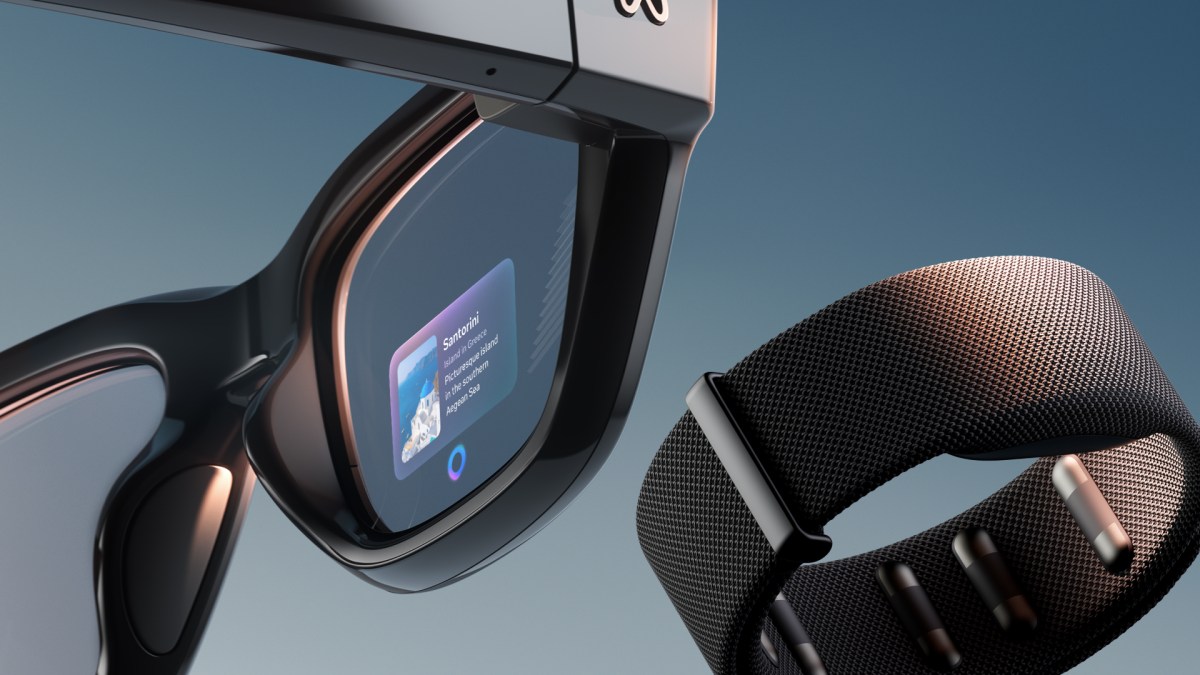
The signal comes from muscles, not private thoughts
Surface electromyography, or sEMG, measures electrical signals associated with muscle activity using electrodes against the skin. The 2025 Nature paper by Kaifosh, Reardon and the CTRL-labs team describes a wrist interface with decoding models trained on data from thousands of consenting participants. It is a non-invasive input system built around hand and wrist activity.
Calling that a neural interface can invite an unhelpful leap to mind reading. The useful interpretation is more concrete: the system learns how activity in the relevant muscles corresponds to intended input. A small finger movement may be enough to select an item without raising a hand into view. That is valuable for glasses because the display can be available while the usual touchscreen or keyboard remains in a pocket or on a desk.
Kaifosh, Reardon and CTRL-labs: generic non-invasive neuromotor interface ↗
The handwriting result is impressive and bounded
The paper reports a median 20.9 words per minute in its closed-loop handwriting task, with better performance after personalizing the model. That is a research result for a described system and task. It is not a promise that any consumer band can immediately replace a keyboard at that speed.
Our reading is that the result demonstrates expressive input beyond a simple button press. The next question is how well that capability survives ordinary use: changing wrist position, interrupted attention and the need to correct mistakes. A demonstration can show that decoding works. A product must also make editing, confirmation and cancellation easy. An incorrectly recognized action is more disruptive when it changes something than when it merely moves a pointer on a test screen.
Kaifosh, Reardon and CTRL-labs: generic non-invasive neuromotor interface ↗
- 01Muscle activityProduces electrical signals
- 02Skin electrodesSense surface potentials
- 03Pattern decodingClassifies the signal
- 04Digital actionMoves or selects an item
A conceptual surface-EMG interface. It measures electrical activity near muscles, not thoughts.
SmartWearGuide illustration · Sources in the articleThe commercial starting point is simpler
Meta's September 2025 Ray-Ban Display announcement introduced Neural Band as a way to scroll, click and control glasses with subtle gestures. In that announcement, writing out messages was described as a future capability. The manufacturer also claimed up to 18 hours from the band and offered multiple sizes for fit.
Those details should not be blended with the research handwriting number into an invented retail specification. The consumer value starts with reliable small commands. If a pinch opens the wrong card often enough, more expressive input will not solve the immediate problem. We would first test how consistently the band recognizes a few ordinary actions, how clearly the glasses acknowledge them and how easy it is to reverse an accidental input. The complete interaction matters more than the sensor alone.
Research is already exploring surfaces around you
The February 2026 TouchFusion preprint combines sEMG with bioimpedance, inertial and optical sensing. Its authors describe a 100-participant dataset and demonstrate interactions with nearby surfaces, including using a palm or table as a touch interface. This is primary research available as a preprint, not a documented feature of the retail Neural Band.
The direction is notable because the environment can become part of the interface without placing a camera at every touch point. A wearable might distinguish gestures or touches through multiple signals instead of relying on one sensor type to solve every ambiguity. The question for consumers will remain the same: which interactions become easy and dependable outside the laboratory? A research prototype's flexibility is a reason to follow the work, not to assume it will arrive in the next software update.
Quiet input can change where glasses are useful
Voice commands are convenient until speaking is inconvenient. A silent control method could make brief interactions easier in a meeting, on public transport or beside someone who is resting. That is our inference about the design opportunity, rather than a claim about how every owner uses an EMG band.
Quiet input also requires clear feedback. If a subtle gesture has no visible acknowledgement, the wearer may repeat it and accidentally issue the command twice. If every selection is followed by a large animation or long confirmation, the quiet interface may still interrupt attention. The best version would make the ordinary action predictable: initiate, see that it worked, and dismiss it. That small loop is the foundation on which more complex gesture vocabularies should be built.
SmartWearGuide analysis
Judge the wrist and display as one interface
A band adds a second thing to wear and charge. Its benefits need to justify that addition. Try the fit while typing, holding a bag and resting a hand in a normal position. Check how the system behaves when you are doing something that was not meant as a command. Those are proposed trial tasks, not reported failures of a product.
The research makes wrist-based input one of the most credible ideas in wearable interaction. The market will be shaped by which manufacturer turns that capability into a small set of useful, understandable actions. The decisive achievement may be less spectacular than handwriting a paragraph in the air: selecting the right item, at the right moment, without talking or reaching for the glasses. A dependable interface is what makes the display worth having in the first place.
SmartWearGuide analysis
About this article
Original analysis checked October 12, 2026, using a peer-reviewed Nature paper, Meta's commercial announcement and a 2026 TouchFusion preprint. The laboratory handwriting result is not a retail Neural Band specification. Surface EMG measures muscle signals; no mind-reading or universal accessibility claim is made.