MicroLED vs micro-OLED: why millions of nits do not settle the smart glasses race.
Tiny displays serve very different optical systems. Understanding where brightness is measured makes the spectacular numbers much less confusing.
 SmartWearGuide · 2026-10-12
Start with the kind of image, not the acronym
The 2025 microdisplay technology review in Nature Reviews Electrical Engineering describes several display families built for near-eye systems, including OLED-on-silicon and LED-on-silicon. A tiny pixel array is only one part of the light engine. The optics then determine how that image reaches the wearer, at what size and with what contrast against the surroundings.
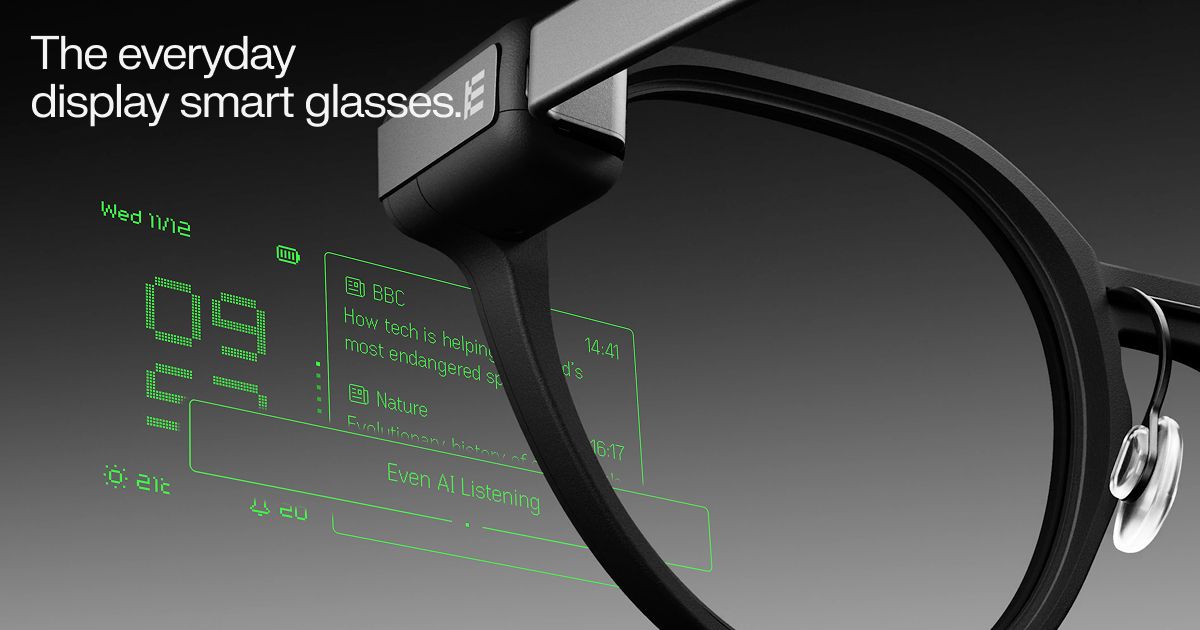
That context separates two common smart glasses jobs. One is a colourful private screen for films, games and documents. Another is a small amount of information that stays visible through a transparent lens in daylight. Both benefit from compact displays, but they do not have identical demands. A technology well suited to a vivid indoor cinema view may face a different challenge when a waveguide has to deliver a readable outdoor notification.
Microdisplay technologies in augmented reality and virtual reality headsets ↗
Micro-OLED already has a detailed engineering story
Sony's historical ECX344A announcement illustrates the sophistication available in OLED microdisplays: a high-resolution silicon-backed display, high-speed drive electronics and modes that reduce processing or transferred data. The 2023 release describes a 90 fps maximum and a foveated scan mode whose specified setting reduces transferred data by roughly 60 percent.
That percentage belongs to a mode in that component announcement. It is not a promise that an arbitrary pair of glasses gains 60 percent more battery life. The distinction shows how misleading a technical number becomes when moved to the wrong layer. Reducing transmitted image data can ease one workload; the complete wearable still has display power, sensors, audio, host rendering and other demands. Sony's example is useful as engineering background, not evidence that every consumer product uses this particular panel.
The enormous microLED number is real in a narrow sense
JBD's 0.13-inch Hummingbird specification lists a monochrome 640 by 480 display with four-micrometre pixels, typical power of 60 mW and a claimed green luminance reaching five million nits. It also labels the component in production. The figures describe a tiny display at its source, with the colour and operating context stated by the supplier.
They do not mean the wearer's eye receives a five-million-nit picture. Light is lost and redistributed between source and eye, while the optics, the image's area and the chosen operating level change the result. Reading only the largest luminance figure can therefore reward the wrong device. The meaningful comparison for a buyer is the visibility of a finished image in the intended setting, with comparable brightness definitions and measurement conditions.
Full colour adds another set of choices
JBD separately lists monochrome projectors, polychrome projectors and optical modules. A display, a projector and an optical module are different products; their quoted weight, power and brightness cannot be mixed into one imaginary specification. The current range includes a full-colour optical module described with a 30-degree field of view and 6,000-nit output, a very different scope from the bare monochrome display.
This is where supplier comparisons should become more disciplined. Ask whether an announcement describes one colour or a complete RGB image, the module's size and the optics included. A navigation device showing a few symbols may make an entirely different choice from a display intended for video. More colour can be worth its complexity, but it is not automatically a benefit if the user's main task is reading two lines of text.
Who is ahead depends on the finish line
Sony and JBD illustrate two areas of progress: detailed, high-resolution OLED microdisplay engineering and very compact, high-brightness microLED components. This article does not rank their entire businesses or claim that one architecture will replace the other. The source documents are not a controlled test with identical optics and operating conditions.
Our view is that the most useful finish line is a complete experience. Can a display show the content clearly, maintain a comfortable frame and run for the intended session? What happens outdoors, at low brightness and with the user's prescription? Those questions reward integration rather than a component's isolated record. They also make room for multiple successful designs: a pair for long flights need not win the same contest as a subtle pair worn for short information glances throughout a day.
SmartWearGuide analysis
Four questions to take into a comparison
First, ask where luminance is measured: at the emitting display, after an optical module, or at the eye. Second, ask what the image contains and whether the figure is a peak or typical operating condition. Third, compare resolution and viewing angle together, rather than treating pixel count as a complete description of detail. Finally, look at sustained power and heat in the whole product.
Those questions do not make exciting display announcements less exciting. They reveal what actually improved. A smaller projector may allow a better-looking temple. Better efficiency may permit longer use. More usable image area may make a document easier to read. The winning specification is the one that creates a benefit you can explain without borrowing the marketing phrase printed beside it.
SmartWearGuide analysis
About this article
Original component explainer checked October 12, 2026, using Sony and JBD documentation and a research review. Source-display luminance and in-eye luminance are not interchangeable. These sources do not establish one universally best supplier.