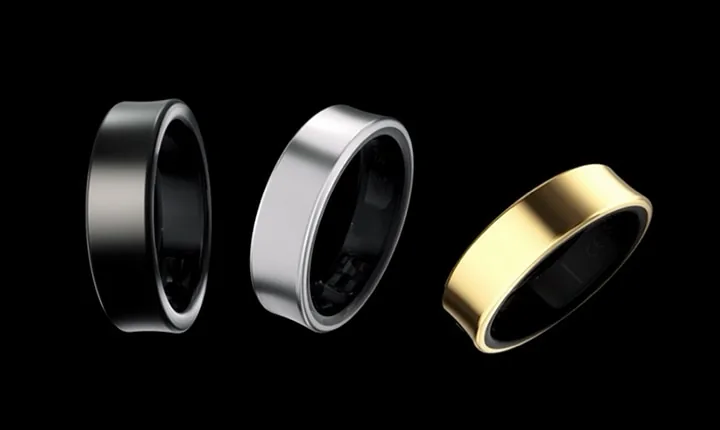
Your smart ring sees a pulse, not your whole health.
A tiny optical signal becomes heart rate, variability and sleep insights through several layers of inference. Here is what those layers can and cannot tell you.
 SmartWearGuide · 2026-10-12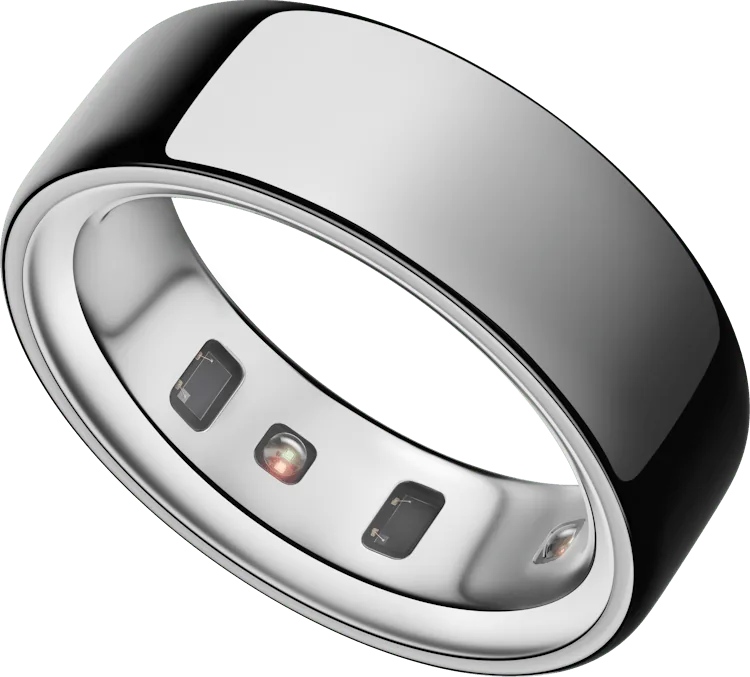
Light in, changing light out
Photoplethysmography, or PPG, uses light to observe changes associated with blood flow in tissue. A ring's LEDs emit light, and photodetectors measure a returning signal. The waveform can then support estimates of pulse timing. Samsung's sensor documentation describes an optical heart-rate sensor alongside an accelerometer and a temperature sensor in Galaxy Ring.
Those measurements are different inputs. Movement can help establish whether a reading happened during activity; skin-temperature trends supply another signal. The device does not directly observe a complete state called recovery or readiness. Those are interpretations constructed from measurements and context. Keeping the layers separate makes a ring less mysterious: there is a physical signal, a processed metric and a summary intended to help the wearer make sense of a day.
Samsung: Galaxy Ring sensors ↗ · Deriving Accurate Nocturnal Heart Rate, rMSSD and Frequency HRV from the Oura Ring ↗
Fit is an optical variable
Oura's Ring 4 explanation describes 18 potential optical signal paths, with the system selecting useful paths and adjusting LED brightness. The manufacturer presents this as a way to adapt to differences in a finger and the way a ring sits. It also describes using the lowest brightness that achieves the desired signal quality, linking sensing to energy use.
That is a more interesting design change than simply adding another sensor label to a list. A ring can rotate, and its contact with a finger is not fixed. An adaptive path offers ways to work with that variability. We still separate Oura's claims from independent measurements of a particular wearer. The first practical step remains careful sizing and consistent wear. A strong algorithm cannot make every physical fit equally useful.
- 01LEDIlluminates the finger
- 02Tissue and bloodChange the reflected light
- 03PhotodiodeMeasures returning light
- 04Signal processingEstimates pulse timing
A simplified reflective PPG signal chain. Motion, fit, skin and circulation affect the signal. A pulse estimate is not an ECG.
SmartWearGuide illustration · Sources in the articleValidation depends on the moment and the metric
An older study compared an Oura ring with ECG during overnight home monitoring in 35 healthy people. It found good agreement for nocturnal heart rate and the HRV metric rMSSD, while some other variability measures were less reliable, especially in short windows. Measurements were collected years before Ring 4 arrived, so this is evidence about the tested generation and conditions.
The important lesson is not that an entire brand is accurate or inaccurate. Accuracy belongs to a metric, a population, an activity and a method. A quiet overnight average and a rapidly changing exercise reading are different tasks. When a product page cites research, look for those details and for the actual hardware used. A result for older sensors can explain a scientific approach without validating every subsequent product.
Accuracy Assessment of Oura Ring Nocturnal Heart Rate and HRV Compared With ECG ↗
A smoother average can hide a messier interval
A later Gen 3 analysis compared ring-derived values with ECG and showed why quality filtering and window length matter. Longer averages reduced differences that could remain noticeable in individual five-minute readings. It also explicitly notes that PPG measures pulse timing, rather than the heart's electrical signature itself.
Our interpretation is that an attractive nightly trend can be useful without every small segment being equally trustworthy. It is also a reason to resist comparing two apps' variability numbers before checking their definitions and averaging rules. A ring may show a different value because it uses a different window or rejects more noisy data. That does not by itself prove that your physiology changed. For longitudinal use, consistency of measurement and clear visibility of missing data can be as valuable as another decimal place.
Deriving Accurate Nocturnal Heart Rate, rMSSD and Frequency HRV from the Oura Ring ↗
A ring is not automatically a new diagnostic tool
The FDA has warned against smartwatches and smart rings that claim to measure blood glucose without piercing the skin and without authorization. That warning concerns the measurement claim; displaying readings from a separate authorized monitor is a different arrangement. A polished app or familiar wearable shape does not establish that a new health function has been validated.
For ordinary wellness tracking, keep the purpose modest: notice patterns and use them as context. A surprising score should not override symptoms, a prescribed treatment or advice from a clinician. We do not use this article to diagnose anything or rank devices for a medical condition. The useful boundary is to verify what a sensor actually measures and what the claimed feature is authorized to do, rather than assume every health-related number has the same standing.
FDA: Do not use smartwatches or smart rings to measure blood glucose ↗
Buy a measurement routine you will keep
The best ring for a particular owner may be the one they can comfortably wear at night, reliably charge and understand in the morning. Consider whether its summaries help you notice a pattern or simply add anxiety and another task. The smallest housing is not automatically the most useful interpretation, and the richest app is not automatically worth its ongoing cost.
Our suggested trial is to write a short account of each day before opening the score: how you slept, what activity you did and how you feel. Compare that account with the app over time. Ask whether the device supplies useful new information and whether gaps are explained. A smart ring earns its place when its measurements help you understand a routine. It does not need to become an authority on your body to be valuable.
SmartWearGuide analysis
About this article
Original sensor explainer checked October 12, 2026. Manufacturer documentation, two validation studies and FDA guidance were read. The older study tested an earlier Oura generation; the later paper tested Gen 3. Neither validates every Ring 4 or Ring 5 feature. This article is not medical advice.