
University of Texas at Austin / Texas A&M
Graphene bioimpedance e-tattoo
Cuffless blood-pressure research
Price not verified
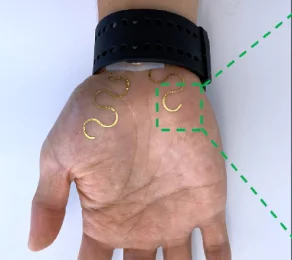
Palm-adhered graphene electronics for ambulatory electrodermal activity sensing.
Physical graphene EDA palm e-tattoo on an open palm. Cropped from Figure 1b, undeformed state, in the authors’ 2022 Nature Communications paper.
An original synthesis of the linked evidence. SmartWearGuide has not hands-on tested this device.
The palm is a valuable but awkward place to put an electrodermal-activity sensor because the hand is constantly touching, gripping and moving. This graphene e-tattoo project focuses on preserving that useful measurement location while reducing the obstruction created by conventional electrodes and connections. Its interest lies as much in the connection to the electronics as in the thin sensing material.
Jang and colleagues' Nature Communications paper describes a flexible interface between the skin-conforming tattoo and a wrist-worn EDA unit. The authors report an ambulatory demonstration covering ordinary activities and examine how the connection tolerates stretching. That is concrete engineering evidence, though the tattoo still works with external hardware; it is not a self-contained invisible computer.
We rank it highly because reliable attachment and interconnection are practical barriers that glamorous wearable concepts often hide. Better contact could make a signal easier to collect without turning the palm into a laboratory fixture. Interpretation remains separate: a conductance change does not uniquely explain a person's emotion or diagnose stress. For readers, the important advance is an approach to wearable measurement mechanics, with the meaning of the signal and the requirements of a finished product still needing careful validation.
Why #3 in this selectionThird because it addresses a difficult real-world interface problem with a published experimental system. Its narrower sensing purpose makes it less broadly illustrative than the first two projects, but the engineering contribution is specific.
The compromiseThis remains a research setup connected to a wrist unit. Skin conductance is not a direct reading of thoughts, emotions or a diagnosis, and ordinary long-term product durability has not been established.
[1] Jang and colleagues: graphene e-tattoos for ambulatory palm EDA, Nature Communications 2022, author-hosted paper [2] Palm E-tattoo Can Tell When You’re Stressed Out - Cockrell School of Engineering - University of Texas at Austin [3] Original graphene palm EDA e-tattoo research [4] Palm E-tattoo Can Tell When You’re Stressed Out - Cockrell School of Engineering - University of Texas at Austin
Research or specialist medical evidence brief. This is not a consumer hands-on review or a treatment recommendation.
Jang and colleagues: graphene e-tattoos for ambulatory palm EDA, Nature Communications 2022, author-hosted paper Original researchPalm E-tattoo Can Tell When You’re Stressed Out - Cockrell School of Engineering - University of Texas at Austin manufacturerOriginal graphene palm EDA e-tattoo research original_researchRelease date not verified · Research or specialist clinical access
Catalogue status: Research prototype. A research publication or demonstration is not a retail release.No verified price in this audit.
Research/clinical system or custom clinical supply; paper prices, grants, treatment fees, insurance reimbursements and component costs are not a device retail price.
EDA correlates with arousal; it is not a standalone mental-health diagnosis.
Prices are snapshots, not a live stock feed. Taxes, shipping, prescription lenses and accessories can change the total.
Cuffless blood-pressure research
Own it, tried it, or still deciding? Share what matters to you.
Start the conversation.
No comments yet. Your experience could help the next person choose.