
Our Top 10 Haptics & body tracking
Ten task-specific selections in a provisional editorial order, with review evidence and gaps explained.
Browse & filter Categories, features & sorting
How price order works
Lowest recorded store prices take priority over announced or launch prices, within the selected source market. Currencies use the dated EUR reference rates. Deposits and recurring charges are excluded from price order; missing prices stay last. Original price records remain visible.
10 current selections
 01First ranking$565 USD≈ €505 EURECB 2026-10-12US · Store price · Delayed dispatchPrice checked 2026-10-12
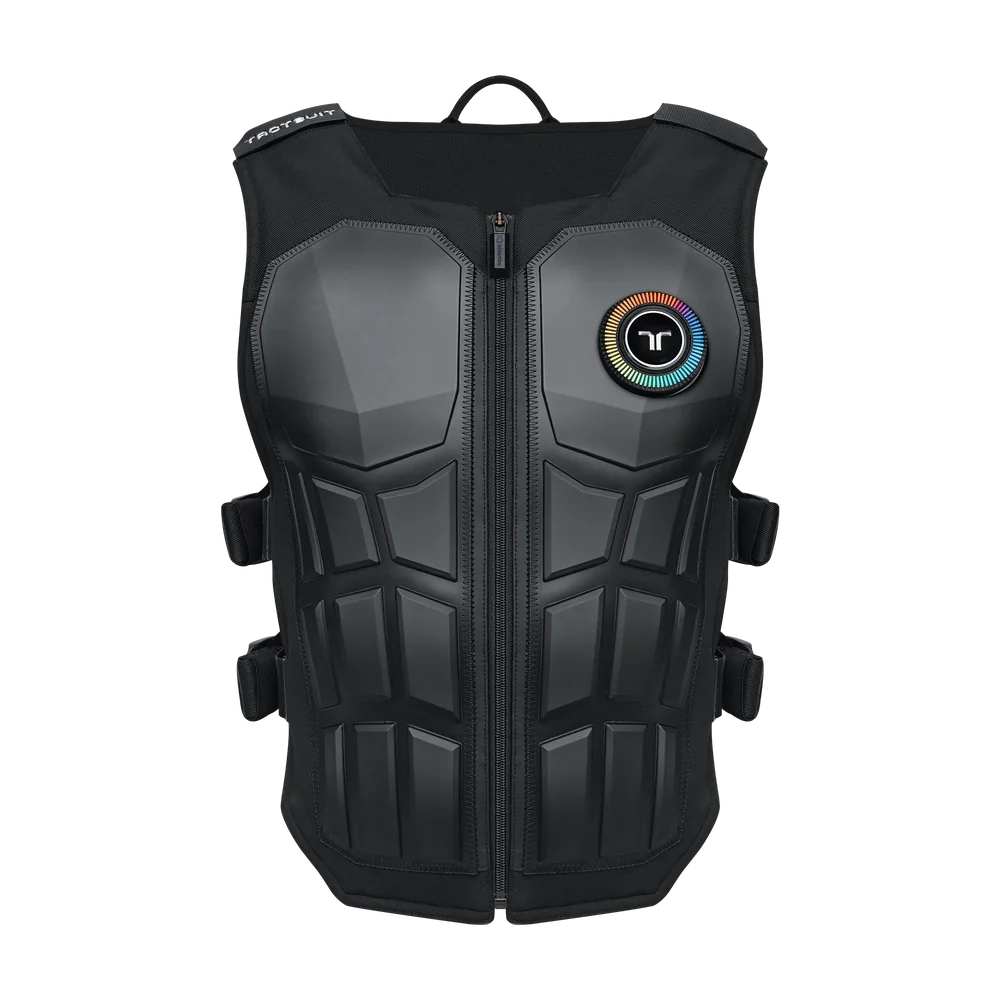
TactSuit Pro has the strongest general gaming case in this group because it adds feedback to software people already play. Thirty-two vibration motors distribute events around the torso; the useful effect is knowing where a supported game wants you to feel an impact, not merely making a soundtrack louder against your body. Native integration is the key purchasing criterion.
Don Hopper tested the Pro for UploadVR using manufacturer-supplied equipment. He found its more extensive motor layout delivered finer feedback, but the thicker vest became uncomfortable during intense sessions. His report also distinguishes authored game effects from audio conversion, which produces a broader, less targeted sensation.
The Pro makes sense if several favourites in your library already support it and you can tolerate another substantial wearable over your clothes. Check those games before counting compatible titles in an advertisement. The stated 13.5-hour runtime comes from a manufacturer duty-cycle test, so it should not be read as continuous maximum-intensity endurance. For occasional use, the lighter Air may be the wiser choice; the Pro earns its lead from richer control rather than universal comfort.
Why #1First for a clear gaming workflow, detailed torso coverage and exact-model firsthand evidence. This is a recommendation for supported content, not every game or every wearer.
The compromiseHeat, weight and game support matter more than the motor count alone. Budget for the complete connection setup and do not expect vibration to reproduce actual force.
Release date not verifiedFirst retail releaseA released catalogue product or explicitly labelled professional offering; exact first retail date was not established in this review pass.Evidence and original sources
Manufacturer documentation plus attributed original review evidence. No SmartWearGuide hands-on test; reviewer experience is not a universal result.
 02First ranking$320 USD≈ €286 EURECB 2026-10-12US · Store price · Delayed dispatchPrice checked 2026-10-12
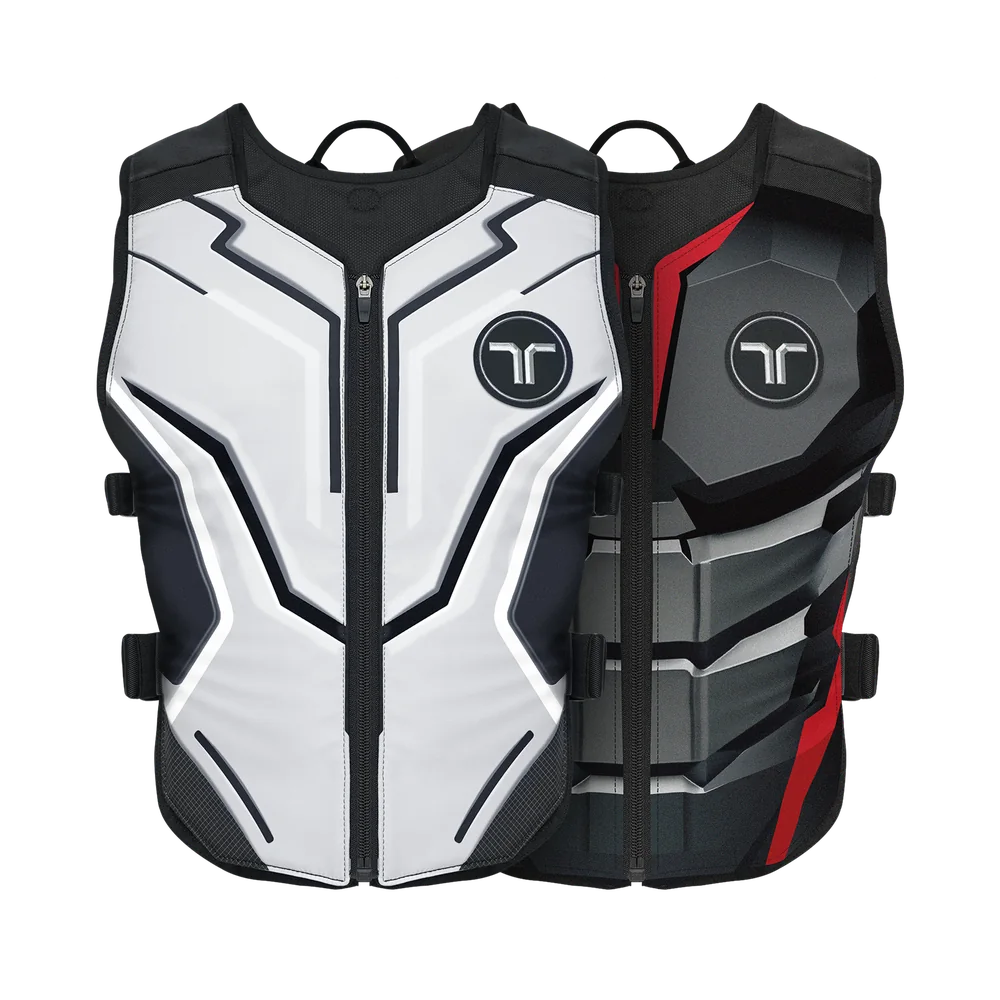
TactSuit Air is the more restrained way to add body feedback to VR. Its sixteen motors provide fewer locations than the Pro, but a lighter garment can be the better accessory if you actually keep wearing it. The point is to enrich supported games without making each session feel like putting on a full simulator rig.
In UploadVR's supplied-sample test, Don Hopper found the Air satisfying in Arizona Sunshine 2 despite the smaller motor array. He also preferred its lighter approach as an entry into the category. That supports its role as a practical alternative, while remaining one reviewer's experience rather than a measured consensus on immersion.
The manufacturer specifies a 1.09 kg body and a twelve-hour duty-cycle runtime. Compare that with your usual session length and tolerance for an extra layer. Check native support for the games you own: audio-to-haptics can broaden compatibility, but it cannot invent precise event placement when a game supplies none. Someone trying haptics for the first time may value comfort and price more than the Pro's additional zones; there is no reason to buy extra motors just to leave the vest on a shelf.
Why #2Second because its simpler, lighter format is easier to justify for a first purchase. It trades some spatial detail for a less demanding wearable setup.
The compromiseThere are fewer feedback locations, and heat still accumulates under a vest. Supported game effects remain more compelling than generic audio conversion.
Release date not verifiedFirst retail releaseA released catalogue product or explicitly labelled professional offering; exact first retail date was not established in this review pass.Evidence and original sources
Manufacturer documentation plus attributed original review evidence. No SmartWearGuide hands-on test; reviewer experience is not a universal result.
 03First rankingBody tracking in an existing SteamVR base-station setup
HTC VIVE Tracker (3.0)
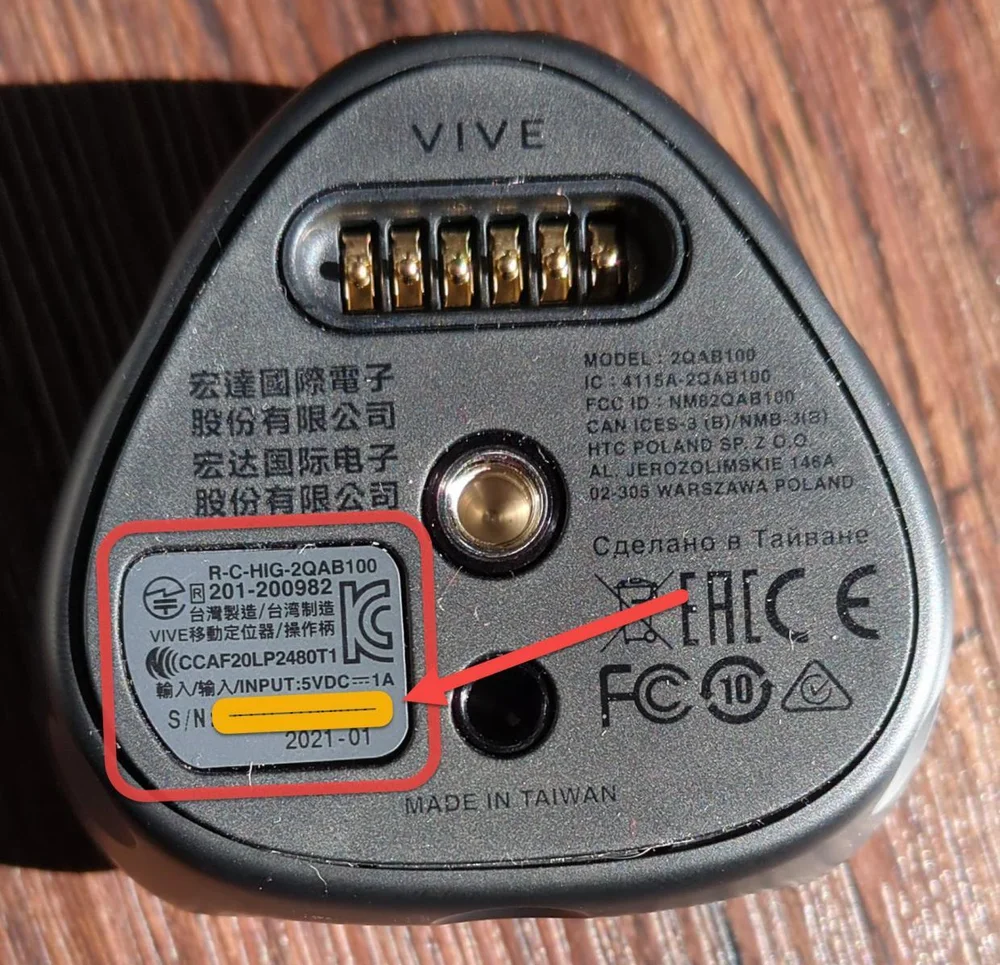
ReleasedSpecifications-led selectionPrice not verifiedVIVE Tracker 3.0 is a straightforward choice when the room already has SteamVR base stations. It adds tracked points to a body or prop rather than generating touch sensations. That can make a larger difference to avatar movement than a haptic accessory, provided the software knows how to use the additional points.
HTC documents support for both generations of SteamVR base stations, a 75 g tracker and up to 7.5 hours of operation. Three or more units are suggested for full-body use, so the real comparison is a complete set with straps, receivers and charging arrangements. A single tracker price is not the price of a tracked body.
The attraction is an established optical tracking architecture with a clearly defined environment. The cost is that the environment matters: base-station placement and visibility need attention, while body mounts must remain secure during movement. We have not measured drift or occlusion recovery against the other options in this list. Choose it for an existing compatible room and workflow; choose an inertial or camera-based system when installing base stations is the main obstacle.
Why #3Third for extending an existing SteamVR room with a well-defined tracking system. It is less compelling when the entire base-station infrastructure must be purchased from scratch.
The compromiseBudget per tracked point, not per product box. Straps, USB connections, base stations and supported software are part of the required setup.
Release date not verifiedFirst retail releaseA released catalogue product or explicitly labelled professional offering; exact first retail date was not established in this review pass.Evidence and original sources
Provisional selection. Manufacturer-backed research brief; no SmartWearGuide hands-on test. Independent comparative performance is not established.
 04First rankingCamera-based body tracking without external base stations
HTC VIVE Ultimate Tracker
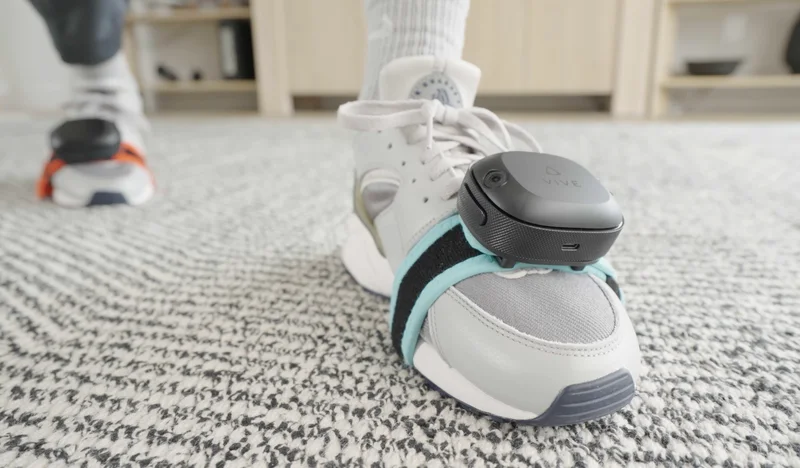
ReleasedSpecifications-led selectionPrice not verifiedUltimate Tracker changes where the tracking work happens. Two wide-angle cameras on each unit estimate its movement, removing the need to install SteamVR base stations. That is a useful distinction for a room that also needs to remain a normal living space, or a setup moved between locations.
Owner-reviewer Kikujin found the movement convincing after software updates, but reported weaker stability near walls and in poor lighting, plus occasional room-recognition friction. Separately, Julian Kulozik and Nathanaël Jarrassé evaluated the exact tracker against OptiTrack in a 2024 research preprint. Their experiments also identified lighting and motion conditions as important limits. The two sources support the convenience while challenging any claim that camera tracking is environment-independent.
Its strongest case is the avoidance of permanent room infrastructure. Before buying a set, verify the exact headset, PC and intended app against the current compatibility documentation. Because the cameras must observe the environment, room conditions and covered lenses belong in any practical trial. The research is not a test of every firmware version or play space, so the recommendation rests on setup flexibility rather than claiming camera tracking always beats optical base stations.
Why #4Fourth for users whose main barrier is installing base stations. Existing SteamVR rooms may get a simpler expansion path from Tracker 3.0 instead.
The compromiseThe dongle, supported software and camera visibility remain requirements. A complete body-tracking purchase usually involves several units and suitable mounts.
Release date not verifiedFirst retail releaseA released catalogue product or explicitly labelled professional offering; exact first retail date was not established in this review pass.Evidence and original sources
Manufacturer documentation plus attributed exact-model firsthand or laboratory evidence. No SmartWearGuide hands-on test; results remain specific to the tested conditions.
VIVE Ultimate Tracker - Full-Body Tracking, SteamVR Support manufacturer Full-Body VR: 8 Reasons You'll Love the VIVE Ultimate Tracker | VIVE Blog manufacturerKikujin: VIVE Ultimate Tracker owner review, revised January 2025 original owner reviewJulian Kulozik and Nathanaël Jarrassé: VIVE Ultimate Tracker precision evaluation original research preprint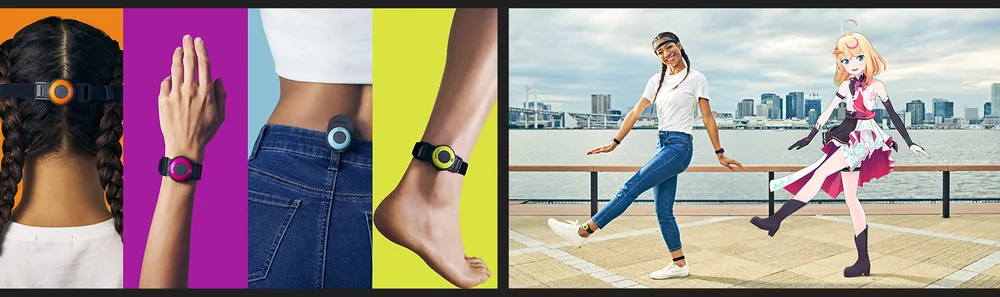 05First ranking$449.99 USD≈ €402 EURECB 2026-10-12US · Store price · Not verifiedPrice checked 2026-10-12
Mocopi is appealing when motion capture needs to travel. Small wearable sensors allow a person to animate an avatar without building a dedicated camera studio. The practical benefit is a setup that can fit into a mobile creative workflow, making it relevant to virtual performers and creators recording away from a permanent workstation.
Dave McQuilling's SlashGear test used Sony-supplied sensors and found the mobile capture idea promising, but reported awkward VRChat setup and difficulty mounting the head sensor with a Quest Pro. Sarah C Awad separately tried Mocopi for exercise capture: setup was easy, but the rear hip sensor made lying on her back uncomfortable. These older reports identify workflow and body-position limits; they do not establish that every later software configuration behaves identically.
Inertial capture also needs realistic expectations about calibration and position. A compact system is attractive precisely because it removes infrastructure, but animation cleanup and consistent fitting can still be part of the workflow. This brief does not claim studio-grade accuracy or compare drift numerically with SlimeVR or optical trackers. Choose Mocopi if portability and an established creator ecosystem solve your actual production problem; a fixed studio may reasonably prioritise tracking performance and integration depth instead.
Why #5Fifth as a provisional portable creator choice. The firsthand evidence favours carefully chosen upright workflows over assuming universal VR or floor-exercise suitability.
The compromiseCheck application support, calibration and export requirements. Portable inertial sensors do not eliminate motion cleanup or establish absolute position perfectly on their own.
Release date not verifiedFirst retail releaseA released catalogue product or explicitly labelled professional offering; exact first retail date was not established in this review pass.Evidence and original sources
Manufacturer documentation plus attributed exact-model firsthand or laboratory evidence. No SmartWearGuide hands-on test; results remain specific to the tested conditions.
Sony Corporation - mocopi manufacturerSony official mocopi QMSS1/USCXK US product store manufacturerDave McQuilling, SlashGear: Sony Mocopi review, July 2023 original hands-on review; Sony-supplied sampleSarah C Awad: three Mocopi exercise-capture trials, March 2024 original firsthand practitioner review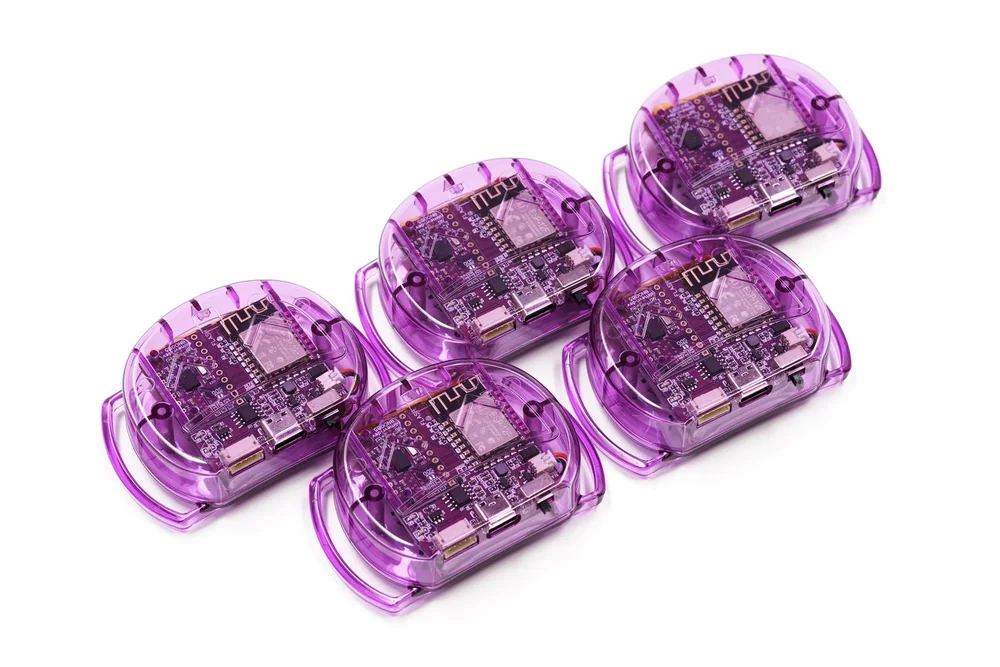 06First rankingOpen-source full-body tracking for hands-on VR users
SlimeVR V1.2
ReleasedSpecifications-led selection$259 USD≈ €232 EURECB 2026-10-12Global · Store price · PreorderPrice checked 2026-10-12SlimeVR is compelling for users who value an open system and are willing to learn its setup. Body-mounted inertial trackers estimate movement without requiring a network of optical base stations. The attraction is flexibility and community tooling, not a promise that every kit behaves like an expensive studio capture system.
The official project explains the software, calibration and body configuration needed to turn sensor orientation into an avatar pose. That process is central to the experience. Strap placement, the number of tracked points and the quality of the body calibration affect the result, so comparing a basic kit with a larger set by price alone can be misleading.
Choose the documented V1.2 offering when you want to understand and adjust the pipeline rather than have every decision hidden behind a commercial application. Inertial tracking can need recentering and cannot simply inherit the absolute spatial reference of optical base stations. We have not measured this kit against VIVE or Mocopi. Its lower position reflects the work expected from the owner; for someone who enjoys an open ecosystem, that same characteristic can be the main reason to buy it.
Why #6Sixth for the open-source route and lack of base-station installation. The trade is greater responsibility for setup and calibration.
The compromiseAllow time to learn placement, calibration and software updates. Confirm the actual kit contents and delivery status, and do not confuse this released version with Butterfly pre-orders.
Release date not verifiedFirst retail releaseA released catalogue product or explicitly labelled professional offering; exact first retail date was not established in this review pass.Evidence and original sources
Provisional selection. Manufacturer-backed research brief; no SmartWearGuide hands-on test. Independent comparative performance is not established.
 07First ranking$130 USD≈ €116 EURECB 2026-10-12US · Store price · Stock and delivery not verifiedPrice checked 2026-10-12
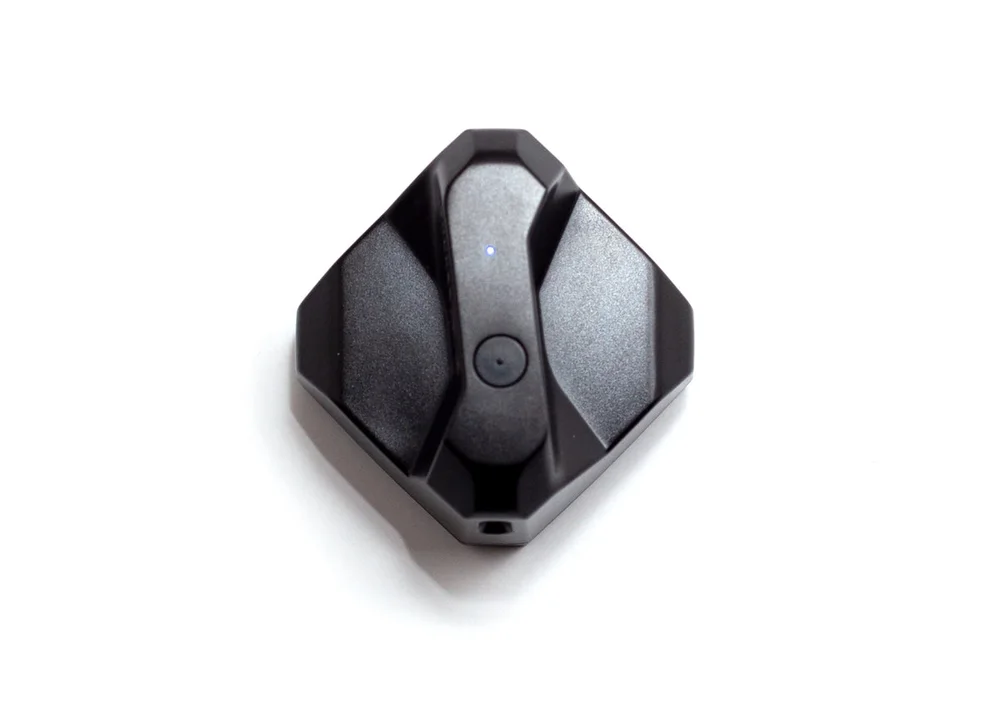
Tundra Tracker is an alternative for someone who already understands SteamVR tracking and wants compact body-mounted units. Its hardware documentation identifies eighteen optical sensors and interchangeable mounting arrangements. The sensors must remain visible, so mount placement is a functional decision rather than merely a comfort choice.
The manufacturer lists compatibility with SteamVR 1.0 and 2.0 base stations and several receiver options. It also states an average nine-hour runtime. A compatible receiver, a sensible USB layout and straps belong in the complete shopping list; an additional tracker listing should not be mistaken for a full-body starter package.
The product is most persuasive as a modular addition to an existing setup. A threaded mount can serve a prop or custom fixture, while the strap-loop arrangement serves body capture. Check which plate and receiver are included in the exact order. We did not establish an independent tracking comparison in this pass, so the review does not claim Tundra is more accurate than VIVE. Its value is the documented small-format hardware and flexibility for a user already invested in the ecosystem.
Why #7Seventh as a specialist expansion choice for existing SteamVR users. It can outrank broader options when compact mounts and receiver arrangements are the deciding needs.
The compromiseOptical sensors still need visibility. Bundle contents, straps and receivers determine the real system cost, and current availability should be checked before planning a multi-tracker build.
Release date not verifiedFirst retail releaseA released catalogue product or explicitly labelled professional offering; exact first retail date was not established in this review pass.Evidence and original sources
Provisional selection. Manufacturer-backed research brief; no SmartWearGuide hands-on test. Independent comparative performance is not established.
 08First ranking€6,299 EUR≈ $7,043 USDECB 2026-10-12EU · Store price · Stock and delivery not verifiedPrice checked 2026-10-12
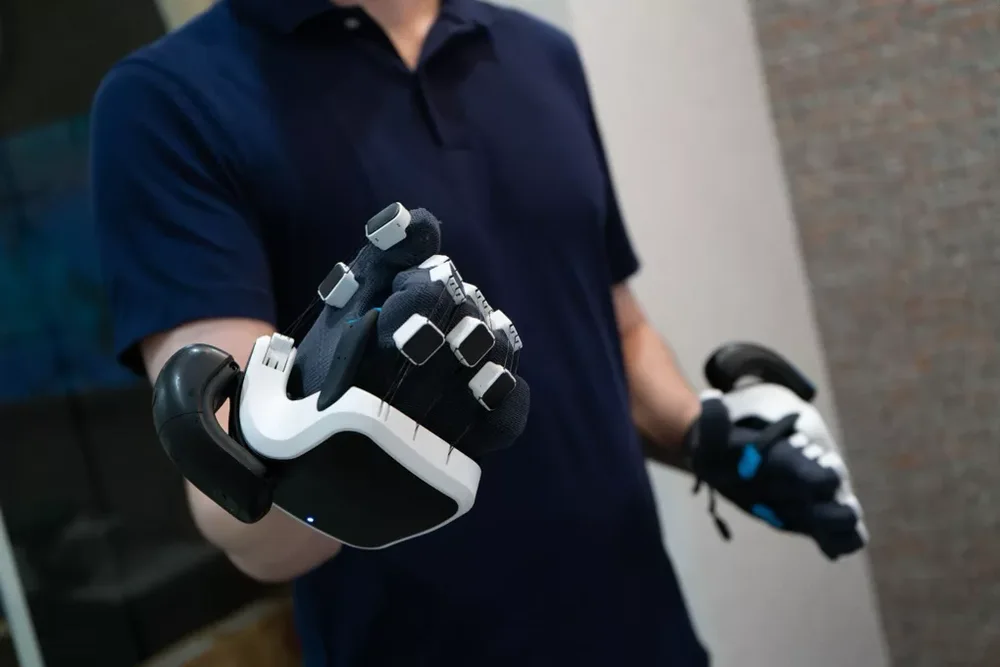
Nova 2 addresses a limitation that a vibrating vest cannot: fingers should encounter resistance when a virtual hand closes around an object. Its passive magnetic brakes and active palm strap give developers a way to convey grasping and contact. That makes it relevant to professional training and research where hand interaction is part of the lesson.
Ryota Musha tried the exact NOVA 2 for Mogura VR in October 2024. He described quick calibration and convincing distinctions between pressing a surface, gripping a hard object and simulated flowing liquid. That is useful original demonstration evidence for combining palm pressure with finger resistance. It remains a supervised demo, not a long-term training study or proof that the glove improves learning outcomes.
Its strongest case is a defined training application with software integration already planned. A glove demonstration is not a ready-made training course, and the complete system includes tracking, application development and fit management for multiple users. We have not validated learning outcomes or force fidelity ourselves. Nova 2 earns a place because its interaction method is materially different from vibration accessories, with the professional procurement and integration burden made explicit.
Why #8Eighth as a professional hand-interaction system. It is much more specialised than consumer haptics, and should be judged against a training task rather than game-library size.
The compromiseExternal tracking and software integration add substantial complexity. Resistance feedback is not unrestricted physical force, and glove fit influences the experience.
Release date not verifiedFirst retail releaseA released catalogue product or explicitly labelled professional offering; exact first retail date was not established in this review pass.Evidence and original sources
Manufacturer documentation plus attributed exact-model firsthand or laboratory evidence. No SmartWearGuide hands-on test; results remain specific to the tested conditions.
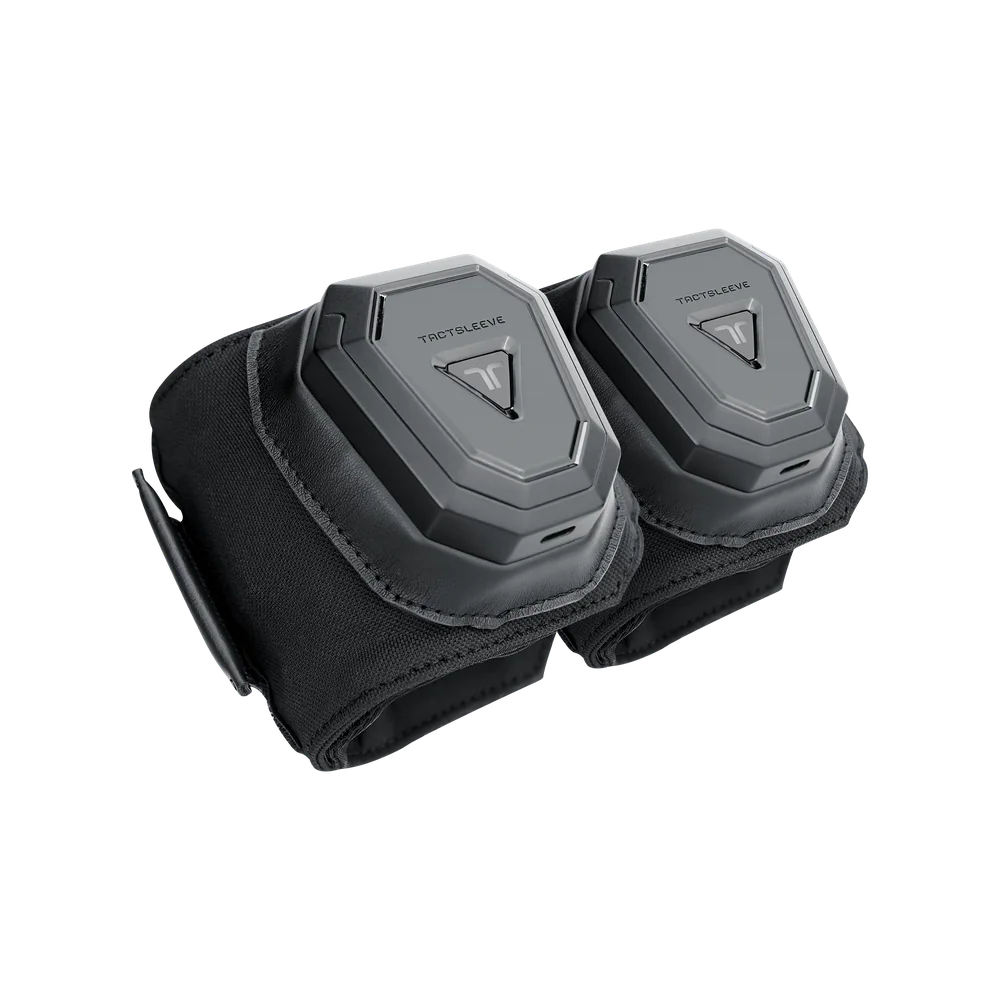 09First rankingForearm feedback for an existing haptic gaming setup
bHaptics TactSleeve
ReleasedPublished testing linked$225 USD≈ €201 EURECB 2026-10-12US · Store price · Delayed dispatchPrice checked 2026-10-12TactSleeve is an expansion accessory, not the natural first purchase in body haptics. It moves feedback onto the forearms, which can make supported weapon handling and impacts more spatially coherent when paired with a torso vest. The benefit depends on the game sending appropriate signals to the arms.
Don Hopper's UploadVR test found the sleeves helped complete the experience, but he also reported pressure around the inner elbow and grip material pulling arm hair as he sweated. Those observations are particularly relevant to a device that must stay tight enough to maintain contact during movement.
The current manufacturer page specifies three motors per arm, which we retain over the different motor count in the review. That illustrates why specifications and subjective observations are checked separately. At a stated 185 g each and ten-hour duty-cycle runtime, the sleeves add more wearable hardware to charge and fit. They make most sense after you know that your favourite games and existing vest justify the additional setup. Start with low intensity and assess whether the cuffs remain comfortable through a normal session.
Why #9Ninth because it adds useful coverage to an already successful haptic setup. Its narrower role and comfort compromises make it a secondary purchase.
The compromiseCuff pressure, sweat and grip contact can interrupt immersion. Confirm native sleeve support rather than assuming that any game supporting a vest also uses the arms well.
Release date not verifiedFirst retail releaseA released catalogue product or explicitly labelled professional offering; exact first retail date was not established in this review pass.Evidence and original sources
Manufacturer documentation plus attributed original review evidence. No SmartWearGuide hands-on test; reviewer experience is not a universal result.
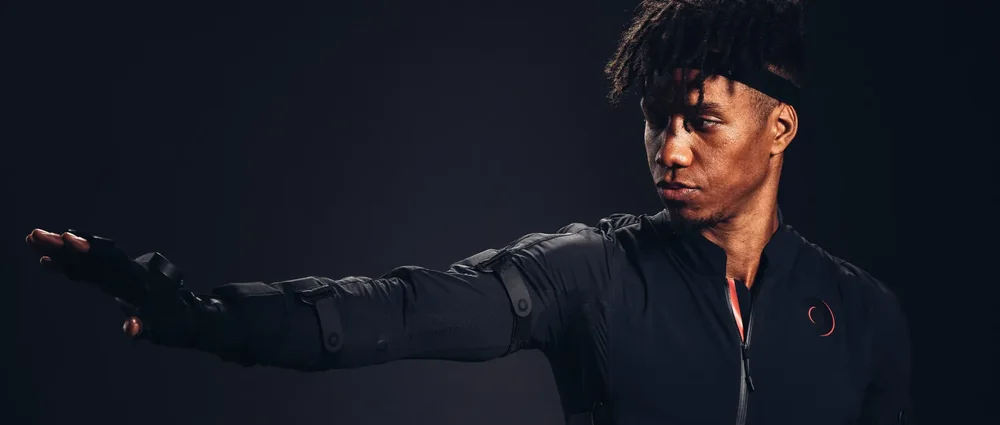 10First rankingProfessional full-body animation capture
Rokoko Smartsuit Pro II
ProfessionalSpecifications-led selection$2,295 USD≈ €2,053 EURECB 2026-10-12US · Store price · Listed availablePrice checked 2026-10-12Smartsuit Pro II belongs here as a professional motion-capture tool, not a haptic garment. It records a performer's movement for animation and virtual production. The useful purchase question is how efficiently that movement reaches the production pipeline, including the time spent fitting, calibrating and cleaning up the result.
Rokoko's product documentation connects the wearable suit with its capture software and supported animation workflows. That integration can be more valuable to a small studio than a single headline sensor specification. The suit also gives repeated sensor placement a physical framework, rather than requiring a fresh improvised arrangement of individual straps for every recording.
Buy against a defined output: a live avatar stream, an animation clip or a production session with several performers. Check the software tier, export format and licences needed for that output, and trial the motion types that matter to the project. This manufacturer-backed brief does not establish optical-studio equivalence or promise clean final animation without editing. It earns its specialist place because a cohesive suit-and-software workflow can save setup friction when motion capture is regular work.
Why #10Tenth as an explicitly professional procurement option. It complements the consumer list by covering production capture, with a very different cost and operating model.
The compromiseSoftware access and post-processing are part of ownership. Hand or finger capture may require separate equipment; a body suit alone does not capture every performance detail.
Release date not verifiedFirst retail releaseA released catalogue product or explicitly labelled professional offering; exact first retail date was not established in this review pass.Evidence and original sources
Provisional selection. Manufacturer-backed research brief; no SmartWearGuide hands-on test. Independent comparative performance is not established.
Ranking history
This is the first published edition. Previous positions will appear after a real revision.
Edition 1 · Oct 13, 2026 · Current
2026-10-13: Added ten substantive model-specific reviews, explained placement and tradeoffs, and distinguished firsthand reporting from manufacturer-backed briefs. Follow-up added exact-model firsthand and laboratory evidence to eleven more entries; provisional placement is now explicit.
How we choose and track positions
SmartWearGuide’s order is an editorial judgment from linked specifications and published testing. We have not performed house hands-on tests. We prioritise a useful daily job, fit, compatibility, complete cost, software support and the strength of the evidence. Category-specific criteria appear on each list. Lower-confidence and specialist selections are labelled; a higher rank cannot guarantee a better fit for you.
Current-product lists contain released, unrecalled models and explicitly labelled professional equipment. The Frontier & research selection is a separate research watchlist, not a shopping recommendation. Music & creative wearables explicitly separates eight released choices from two preorder or reservation projects. Best Upcoming covers announced products and early evidence. A released product is not necessarily in stock in your country. No brand pays for a place in these lists.
History begins with the first edition published here. Each substantive revision appends a dated edition and reason; past editions are preserved. Up, down and previous position compare the latest two published editions of the same list. We do not invent an earlier chart, move products to manufacture news, or turn an announcement date into a shipment date.